
The forts
Castillo San Felipe del Morro guards the harbor mouth; Castillo San Cristóbal, the largest Spanish fort in the Americas, guards the land side. Together with the city walls they are San Juan National Historic Site, run by the National Park Service and a UNESCO World Heritage site. One $10 pass covers both forts for 24 hours; children 15 and under are free; the park does not take cash, so bring a card. Both are open 9 am to 5 pm daily, closed Thanksgiving, Christmas and New Year's Day. A $35 annual pass covers four adults if you are coming back. NPS: fees NPS: plan your visit
- Do El Morro at opening or in the last 90 minutes. The lawn in front is the best picnic and kite spot in the city; the trade wind never stops and locals have flown kites there for generations. Midday in summer is brutal.
- San Cristóbal is the one people skip, and it is the better fort: tunnels, the Garita del Diablo on the ocean side, and the view east along the wall to La Perla. The main entrance is on Calle Norzagaray by Plaza Colón.
- Kids: free Junior Ranger booklets at the entrance in English or Spanish. Complete three activities and a ranger swears them in with a badge. NPS: Junior Ranger
- Restrooms are inside each fort. The old city has almost no public ones otherwise; cafés are the fallback.
- Free days: listed on the when to go page.

A walk along the wall, two to three hours
Start at the bottom of the hill and work up. Everything here is free unless marked.
- Paseo de la Princesa. A half-mile promenade under the wall, built in the 1850s. The pink building was the city prison until 1965 and is now the Tourism Company; the fountain at the end, Raíces (1992), is the island's three roots in bronze. Weekends bring vendors, live music and piragua carts. Paseo de la Princesa
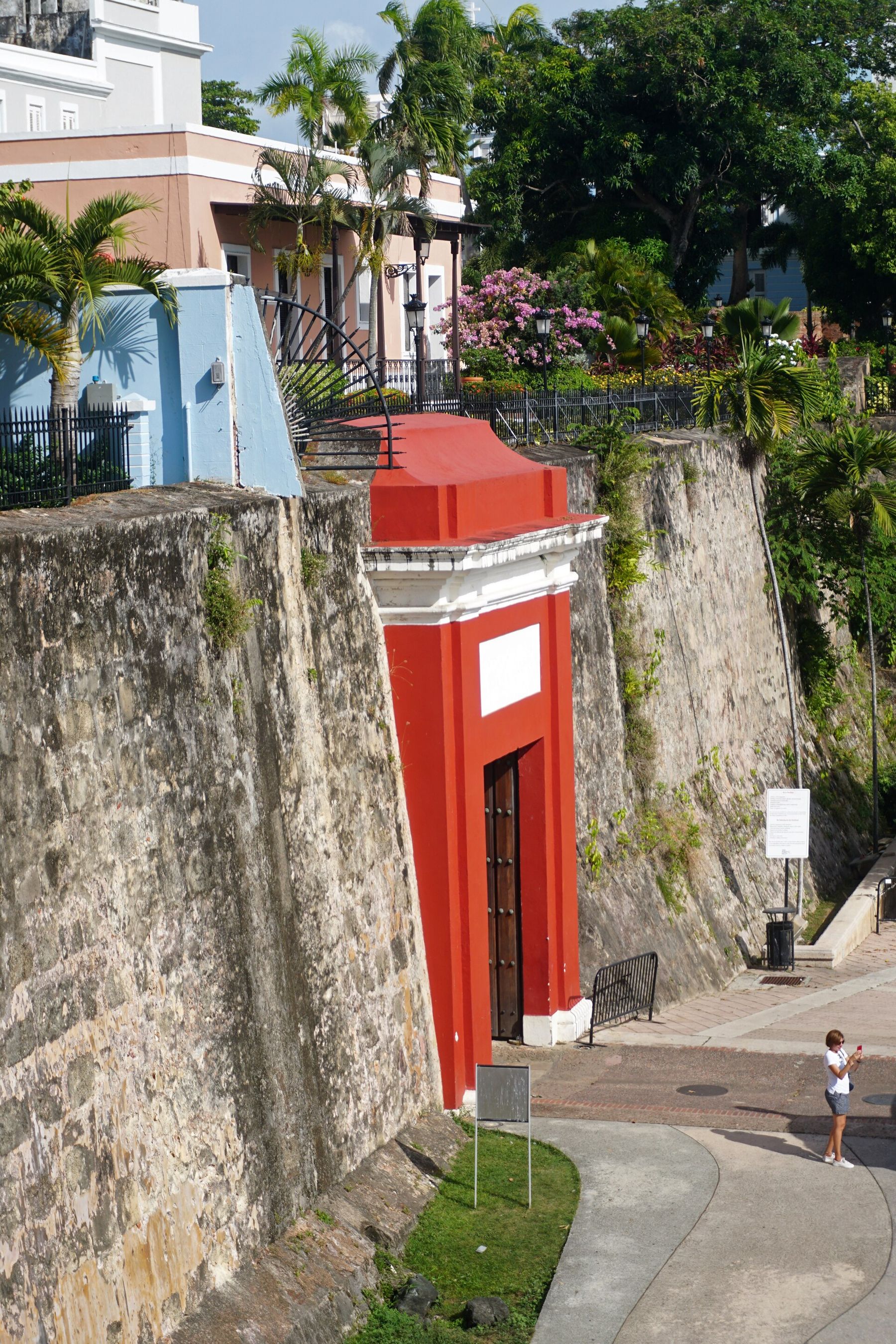
- Puerta de San Juan. The 1634 red gate at the end of the paseo, the only one of the five city gates left. Governors arriving from Spain walked through it to the cathedral. Read the inscription over the arch, then go through.
- Plazuela de la Rogativa. Left inside the gate and up the steps. The bronze procession commemorates April 30, 1797, when the British blockaded the city and the women of San Juan marched the walls at night with torches and bells; the fleet, so the story goes, took the lights for reinforcements and sailed away. Best at sunset. La Rogativa
- Casa Blanca. Built in 1521 for Juan Ponce de León, who died before he could move in; his family lived there for 250 years. The gardens are free and the shadiest spot in the city; the house museum is $5, Wednesday to Sunday, mornings and early afternoon (hours have shifted; check before you plan around it). Islands, April 2026
- Catedral de San Juan Bautista. Calle del Cristo. The first wooden church went up in 1521; what you see is mostly 19th century. Ponce de León's tomb is inside. Open weekday mornings and afternoons; Sunday Mass at 9 and 11.
- Calle del Cristo to the chapel. Downhill past the shops to the Capilla del Cristo (1753) at the dead end, usually locked, with the gilded altar visible through the grille, and the Parque de las Palomas beside it: a walled terrace over the harbor where you buy birdseed and get mobbed.
- Plaza de Armas. The city's main square since 1521, with City Hall on the north side and the four seasons in marble. Coffee and a mallorca here; see below.
- Cuartel de Ballajá. Back uphill. A 19th-century Spanish barracks that now holds the Museo de las Américas: Taíno, African and folk art collections, $8 adults, $5 for seniors, students and children, Tuesday to Friday 9 to 4 with a lunch break, weekends 11 to 4. Next to it, the Plaza del Quinto Centenario with the ceramic Tótem and the big underground garage. Museo de las Américas
- The cemetery. Below the wall between El Morro and La Perla, Santa María Magdalena de Pazzis (1863), where Albizu Campos, José de Diego and Rafael Hernández are buried. Photograph it from the wall; the gate hours are irregular.
- El Morro. End on the lawn with the sun going down behind the lighthouse.
La Fortaleza, the governor's mansion since 1846 and the oldest executive residence in continuous use in the Americas, offers guided tours Monday to Friday, 8:15 am to 3:30 pm, about 30 minutes, gardens plus the interior when the government is not in session. Call ahead; it closes without notice. Photo ID. Discover Puerto Rico: La Fortaleza
The streets
The blue-grey cobblestones are adoquines: iron slag, by local tradition brought over as ship ballast, worn blue by weather. A lot of them were relaid in the 1950s restoration that saved the district from demolition. They are murder on heels and slick when wet. Calle Fortaleza is the street with the famous umbrellas; the umbrellas are a seasonal installation and were not up as of late 2025, replaced by a Christmas stage and a monthly last-Sunday event series. Do not plan a trip around them. San Juan Daily Star, January 2026

For shopping, Calle del Cristo and Calle Fortaleza are the strip: Puerto Rican Arts & Crafts on Fortaleza for vejigante masks and carved santos, Don Collins at 59 Cristo for Toa Alta cigars and Adjuntas coffee. Skip the cruise-terminal jewelry.
Where to eat
- La Bombonera
The mallorca, a sugared sweet bun pressed with ham and cheese, was made famous here. Closed in 2012 and reopened in 2016 under the founder's granddaughter. Go for breakfast.
- Cafetería Mallorca
Eight mallorcas on the menu, counter seating, locals on their lunch break. The ham and cheese one, with café con leche.
- Piraguas
Shaved ice in a cone with tamarind, passion fruit, coconut or raspberry syrup. A few dollars, cash.
- The piña colada
The Caribe Hilton says bartender Monchito Marrero invented it there in 1954. Barrachina on Calle Fortaleza has a plaque claiming 1963. Try both and vote.
More on food, including where the real lechón is, on the Eat page. Small shops and carts here may take Cash App through riverArk; ask.
Parking, the trolley, and cruise days
Do not try to park on the street. The garages that work: Doña Fela on Calle Recinto Sur, open 24 hours, $1.25 the first hour and 50 cents after, with a $3 overnight rate; Covadonga behind the bus terminal; Ballajá under the Quinto Centenario plaza, entered from Calle Norzagaray, closest to the forts; and La Puntilla at the foot of Paseo de la Princesa. Rates drift; these were current in January 2026. Parking in Old San Juan
The free trolley that used to loop the old city is not running. The municipality ran a free weekend shuttle from Escambrón through Plaza Colón to the piers over Christmas 2025, and may again; otherwise it is on foot, which is the point.
Cruise season is October to April, with 541 ship calls expected for 2026 to 2027. On a four-ship day the forts and the Cristo and Fortaleza blocks are packed from 10 to 3. Check the port schedule and come on an empty day, or do the forts at 9 and leave the center for after 4. San Juan Cruise Port

Timing and the heat
Early morning or late afternoon, weekdays, May through November for the thinnest crowds. The city is 75 to 85°F year round and the streets hold heat; there is shade on the north side of each east-west street in the morning and the south side after lunch. Water, a hat, and a plan to be inside a museum or a café from 1 to 3.
Christmas is the exception to every crowd rule and worth it: the lights go on the day after Thanksgiving, La Fortaleza projects a light show on its facade on the half hour in the evenings, and the season ends with the Fiestas de la Calle San Sebastián in January, when the whole island comes to these seven blocks.
Next door
Below the wall on the Atlantic side is La Perla, which has its own page because it needs one. East along the coast, 20 minutes away, is Loíza and the Piñones kiosks, on the day trips page.